Overview of the NeuroomNet CMS
History
The NeuroomNet CMS was originally developed for typical museum and exhibition projects. It is intended to simplify collaboration between media designers, designers, and programmers during a project and to enable the client to maintain the content independently after the project.
As a generic headless CMS, however, it can be used for almost any requirement.
Features
- Editing interface in the browser (CMS frontend) that builds its forms automatically from the description of the data
- Usable together with NeuroomNet or separately from it
- Multi-tenant permission system
- Multilingual content
- Media files including automatically generated thumbnails
- Export and import of entire projects, namespaces, or APIs
- HTTP interface for creating and changing data structures as well as reading and writing data
CMS using the example of a museum
In exhibitions, texts, images, videos, or audio recordings often run in a loop on dedicated playback devices. Such content is frequently copied directly to the playback devices via file transfer (content push).
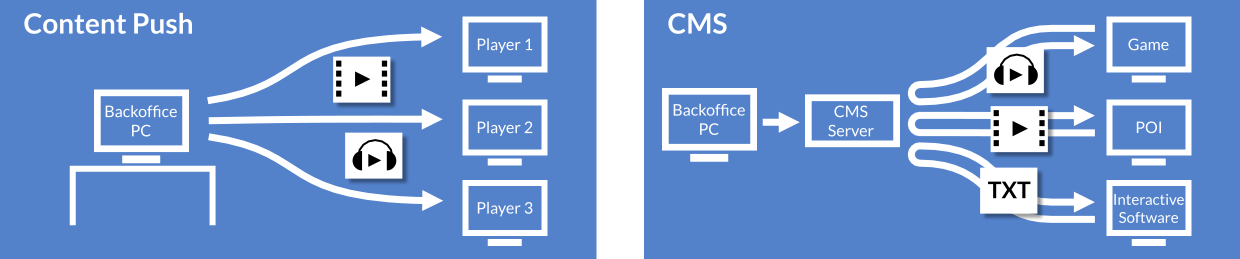
It gets more complicated when the content is part of an interactive application. Without a CMS, exchanging content then quickly becomes expensive, for example when a small text change requires the application to be rebuilt and redeployed on site. Applications should therefore be built so that they fetch their content from a CMS.
That leaves the question of where the CMS runs. If it is reachable from the internet, programming, editorial work, and translation can work in parallel from anywhere. Making a server in the museum reachable from the internet, however, raises security concerns. The CMS can therefore also be operated on the internet for a period of time, with the data transferred to the server in the museum afterwards (see Recommendations for projects).
Not all CMSs are the same
When hearing "CMS", many people think of WordPress, Joomla, or Typo3. These web CMSs essentially create one source, such as a website, that is accessed by many browsers and looks the same everywhere. The CMS determines presentation and behavior.
An exhibition, by contrast, has different applications, such as a game, an information station, and a video slideshow. Appearance and behavior are programmed individually for each, but the content comes from one CMS. The CMS thus only provides content and does not handle presentation. This kind of CMS is called a headless CMS.
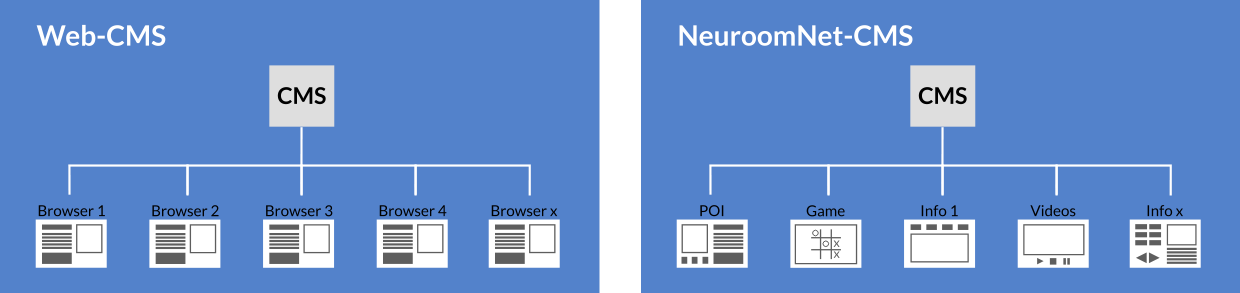
This is particularly important in calls for tenders: anyone who merely requires "a CMS" there may end up with a web CMS that does not provide the desired functionality.